
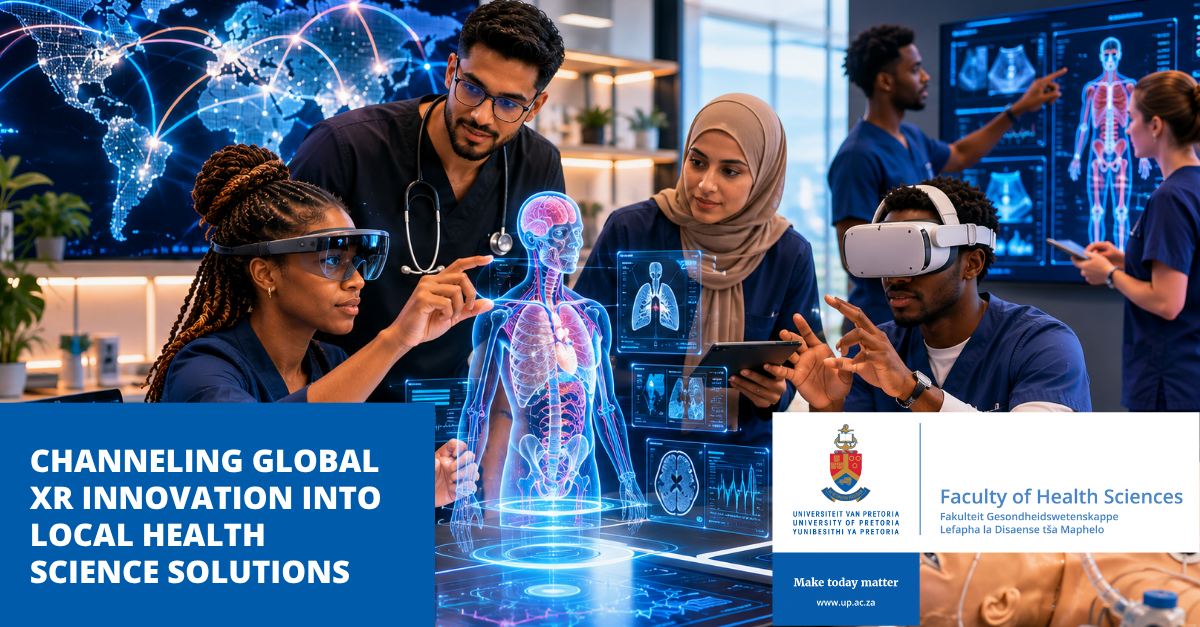
We live in a world of immersive technology that moves at a breathless pace, and the United XR 2025 conference held in Belgium this past December proved that the future is closer than we think. For the University of Pretoria Faculty of Health Sciences (FHS) Simlabs, these international showcases offer more than just a glimpse of high-end hardware; they provide the intellectual blueprints for how we can revolutionise medical education right here in South Africa.
The Awe of High-Fidelity Innovation
Walking through the exhibition halls in Belgium, two particular technologies captured the imagination of the global Extended Reality (XR) community. The first was a staggering full-body jetpack simulation. This device represents the pinnacle of high-fidelity simulation, engaging every muscle group and sense to mimic the complex physics of flight.
While a jetpack has no immediate clinical application in a hospital ward, the engineering behind it is a marvel. It utilises a sophisticated exoskeleton to provide haptic feedback, demanding total physical immersion from the user. For an academic institution like UP, observing these complex, single-purpose devices is vital. It allows our researchers to deconstruct how high-end simulators manage user presence and sensory load, principles that are directly transferable to high-stakes surgical simulations or emergency trauma response training.
Walking into the Future with XelerateVR
The second highlight was XelerateVR, a sophisticated omni-directional treadmill designed for seamless VR movement. Unlike previous iterations of walking simulators, this model employs an ingenious design featuring thousands of tiny metal balls beneath the user’s feet. This creates a low-friction surface that allows a person to “glide” and walk in any direction while remaining physically stationary.
The ability to move naturally within a virtual space is a game-changer for Health Sciences. Imagine a student navigating a virtual community clinic or a complex multi-storey hospital during a disaster simulation. The XelerateVR demonstrates that physical movement is the key to unlocking true spatial awareness in digital environments.
The “Exit Suit” and the FHS Philosophy
At the University of Pretoria, our approach to innovation is rooted in scalability and practical application. While high-fidelity devices like the jetpack simulator are impressive, they are often expensive, large, and complex to maintain.
This is where the FHS Simlabs truly shines. We take the high-level concepts seen at events like United XR and translate them into low-fidelity, cost-effective solutions. A prime example is our own “Exit Suit.” Developed as a proof of concept, the Exit Suit explores how we can provide physical feedback and movement for health sciences students without the prohibitive price tag of international commercial units.
By studying the metal-ball friction system of the XelerateVR, our team can borrow and adapt these mechanical ideas. We aim to transfer that “low-friction” logic into our own scalable models, ensuring that our students benefit from world-class pedagogical theories while maintaining a solution that works within the South African context.
A Future Built on Curiosity
Attending United XR 2025 has reinforced our mission: to observe the impossible and make it accessible. As we continue to refine the Exit Suit and explore new proof-of-concept devices, we remain committed to a future where high-quality simulation isn’t just for those with the biggest budgets, but for every student dedicated to the art of healing. The wonder of Belgian technology today becomes the foundation for South African excellence tomorrow.
See more about the future of medicine by visiting the Centres website here: https://upsimlab.co.za/surgical-skills-lab/
Follow us on LinkedIN.
Recent News
As we look back at the innovations from United XR…
The journey through the United XR 2025 exhibition in Belgium…