
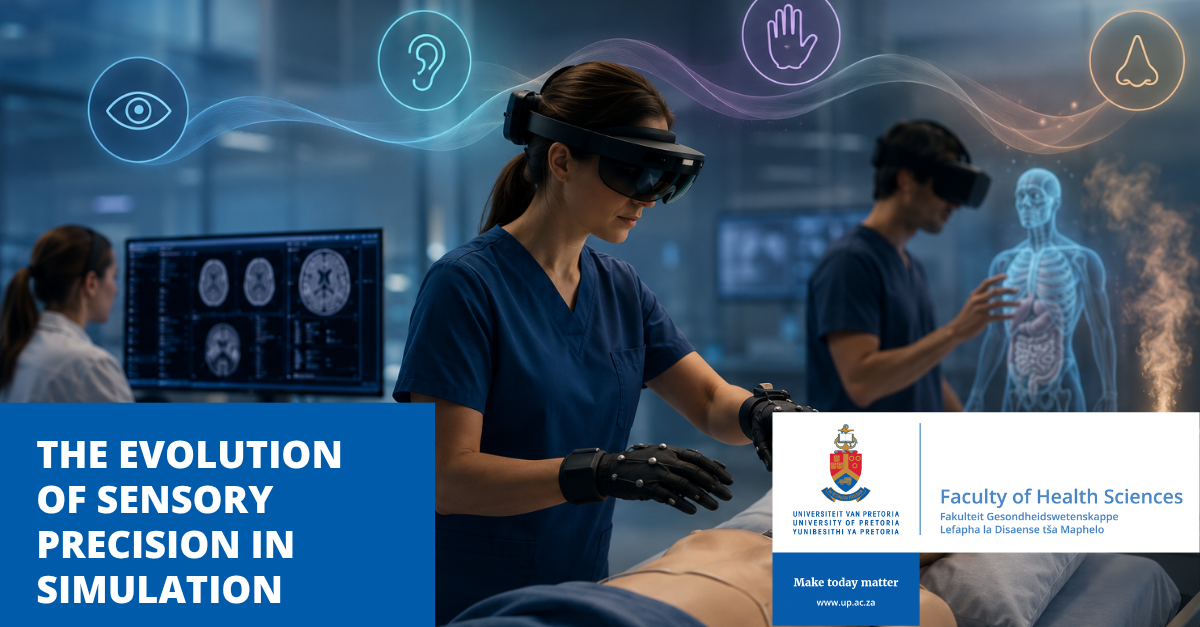
The journey through the United XR 2025 exhibition in Belgium revealed a significant shift in the landscape of immersive technology. While previous years focused heavily on what we see and hear, the latest breakthroughs are grounded in what we feel and smell. For the University of Pretoria Faculty of Health Sciences (FHS) Simlabs, these advancements offer a roadmap for moving from basic visual simulations to deeply immersive, multi-sensory clinical training.
Haptic Feedback: The New Frontier of Accuracy
One of the most compelling displays involved the latest Senseglove and Haptikos systems. These high-fidelity devices are no longer just clunky prototypes. They are becoming increasingly sophisticated through the use of 3D printing and cost-effective sensors.
The Senseglove demonstrates how high-accuracy interaction is now possible by mimicking the resistance one feels when touching a solid object. Similarly, the Haptikos device translates natural hand movements into digital inputs or even controls for robotic limbs. In a medical context, this is revolutionary. Imagine a student feeling the subtle resistance of a needle during a lumbar puncture or the specific tension required for suturing, all within a virtual environment. These devices use intricate designs to map the complex mechanics of the human hand to small, precise sensors, bridging the gap between digital “pointing” and genuine “feeling.”
Multi-Sensory Realism: The Power of Scent
Perhaps the most unexpected leap forward was the Scentient device. By introducing olfactory elements into the virtual space, it creates a truly multi-sensorial experience. In health sciences, scent is a powerful diagnostic tool—certain infections, metabolic states, or environmental hazards have distinct odours. A simulation that includes these cues provides a layer of realism that visual data alone cannot match, preparing students for the raw, sensory-rich reality of a clinical ward.
The FHS Challenge: Scaling Innovation for South Africa
While these experimental platforms are a triumph of engineering, they present a unique challenge for our local context. At the University of Pretoria, our primary focus is the transition from Proof of Concept (POC) to Large-Scale Implementation.
The Scalability Gap: How do we take a successful pilot of 5–10 high-end devices and translate that into a sustainable training programme for 50 to 350 students?
Currently, these international devices remain expensive and complex to maintain at scale. However, their value to us lies in their role as an experimental platform. By observing how these high-fidelity tools function, we can:
- Deconstruct the Tech: Understand the core mechanics (like sensor placement or haptic logic) to see what can be simplified.
- Empower Developers: Use these tools as benchmarks for application developers to create software that is “future-proofed” for when these technologies become more affordable.
- Adapt and Localise: Identify which sensory elements are most critical for clinical competency and find South African-grown, cost-effective ways to replicate them.
The goal for FHS Simlabs is not merely to own the most expensive equipment. We want to lead the way in making these high-fidelity experiences accessible, affordable, and impactful for the next generation of SA healthcare professionals.
See more about the future of medicine by visiting the Centres website here: https://upsimlab.co.za/surgical-skills-lab/
Follow us on LinkedIN.
Recent News
As we look back at the innovations from United XR…
The journey through the United XR 2025 exhibition in Belgium…